
In today's landscape, the very definition of "service" is undergoing a seismic shift. Historically, "Products" (Goods) and "Services" (Actions) were distinct entities. However, the relentless evolution of digital technology has dissolved those boundaries, fundamentally rewriting the rules of how businesses win.
In this article, based on the curriculum of the FOURDIGIT Service Design School, we explore the essence of "Modern Service" in the digital era and the critical role Design plays in it.
1. The Dissolution of Boundaries
Let's strip it back to the basics. Textbooks define products and services as distinct:
- Product: Tangible, ownable, with a time gap between production and consumption. (e.g., Furniture, T-shirts)
- Service: Intangible, unownable, consumed simultaneously with provision. (e.g., Haircuts, Taxi rides)
But does this definition hold up in the modern business world?
Take the smartphone in your hand. It is a "Product," yes. But without the "Service" layers—connectivity, app stores, cloud backups—it's just a slab of glass and metal. Or consider coffee machines. It used to be a one-time hardware sale. Now, it's a continuous service ecosystem involving subscription capsule delivery.
Modern Service is the integration of Product and Service, utilizing digital technology to forge a continuous relationship with the user. The "sell and forget" model is dead. The moment of purchase is no longer the finish line; it is the starting line of a long-term engagement.
2. Why is "Experience Value (UX)" the Imperative Now?
Why are enterprises obsessed with "Experience" and "Service"? Two undeniable macro-trends are driving this shift.
① Tech Evolution & Commoditization
Innovation moves fast, but imitation moves faster. Look at the price trends of digital cameras or TVs. They launch at a premium, but quickly become commoditized, dragging companies into price wars. In an era where "Functionality" is easily replicated, "Experience Value" (Meaningful Value) remains the last bastion of competitive advantage.
② Economic Maturity & The Shift in Values
As economies mature, human desire shifts from the "Ownership of Things" to the "Experience of Moments." People aren't just buying luxury watches; they are investing in "invaluable vacations." Consumers choose brands not for specs, but for the story—how that brand enriches their lives.
3. The Anatomy of Modern Service: Business × Tech × Design
So, how do we build superior Modern Services? They are not born from a single flash of genius. They emerge at the high-level fusion of three critical forces:
- BUSINESS: The dynamics of revenue, profit, and sustainability.
- TECHNOLOGY: The enablers of feasibility, security, and scalability.
- DESIGN: The core understanding of human emotion and behavior, giving form to the abstract.
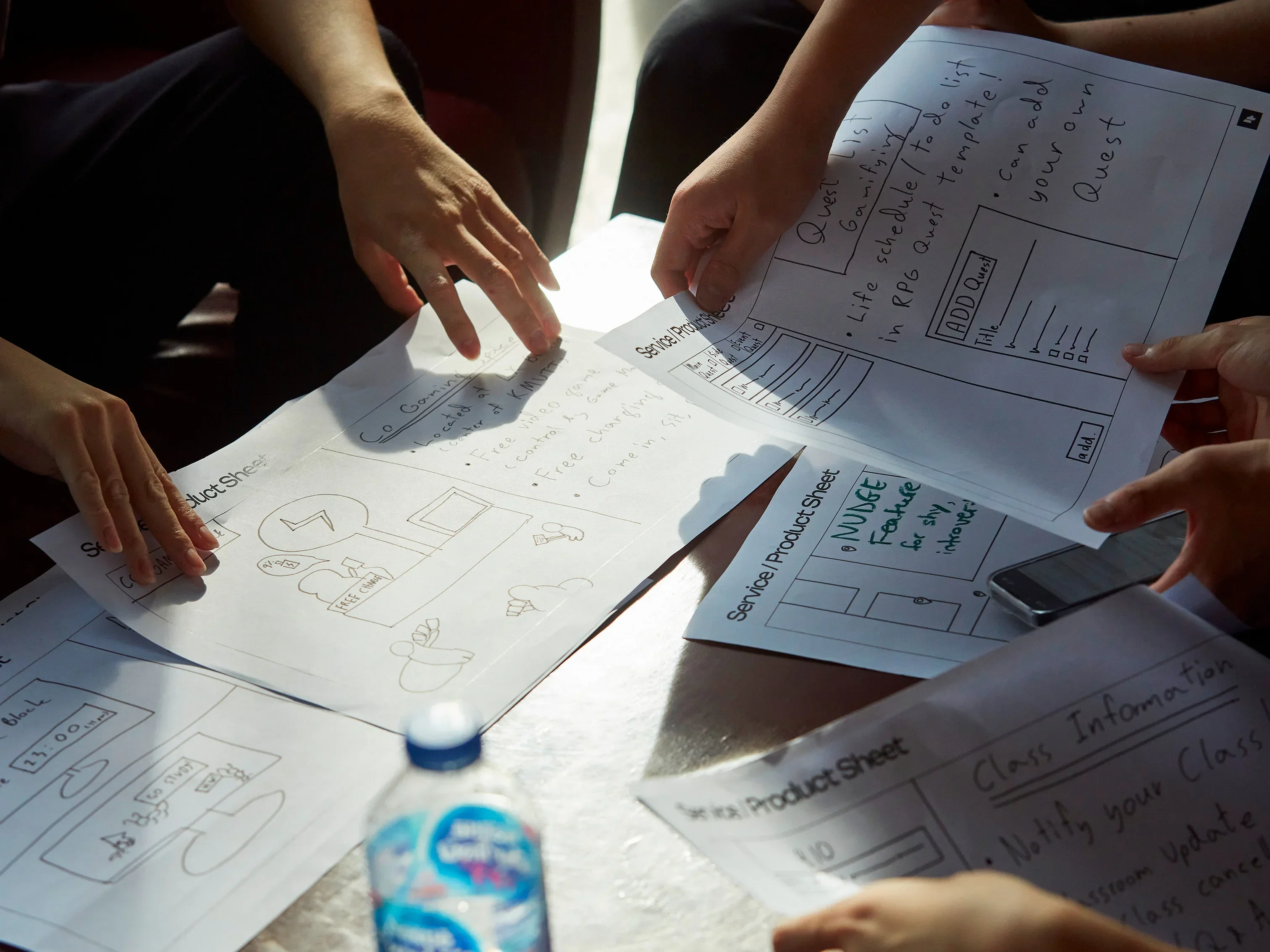
In traditional organizations, these forces are often siloed. However, in Modern Service development, these three distinct dynamics (often with conflicting interests) must be brought to the same table and integrated. Service Design is the process that orchestrates this integration.
4. Design is not "Aesthetics," it is a "Strategic Asset."
When people hear "Design," they often think of making things look pretty. But in the context of Modern Service, the role of Design is far deeper.
- Problem Finding: Unearthing latent needs and "burning desires" through deep user research.
- Consensus Building: Visualizing complex business challenges to align the team's vision.
- Organizational Transformation: Implementing Human-Centered Design (HCD) to reshape decision-making processes.
Apple's success wasn't just about style; it was because Jonathan Ive, a designer, was deeply involved in executive decision-making. Design is not just polishing the surface; it is "the planned act of translating business logic into human meaning and implementing it into society."
5. The Winner in the Digital Age Knows "Humanity"
Finally, as AI and technology accelerate, what remains for us humans?
Technology seeks efficiency. But technology, by itself, has no ethics and no empathy. "It's convenient, but cold." "It works, but I don't love it." To avoid creating such soulless services, creators must deeply understand "human irrationality" and "emotional nuance."
Modern Service Design is the discipline of wielding the immense power of digital technology while keeping "Humanity" firmly at the core.
Conclusion: The Future belongs to Teams with "Will."
Building Modern Services is hard. We face business constraints, technical limitations, and the unpredictability of human reaction. To overcome these hurdles, you need more than just skills—you need the Passion and Will of a united team committed to "building a better future."
Design is the ultimate tool to give form to that will. Are you ready to integrate Design into your strategy and update your business for the new era?
This article is a glimpse into the curriculum provided by the FOURDIGIT Service Design School. For more details on our programs and corporate training, please feel free to contact us!